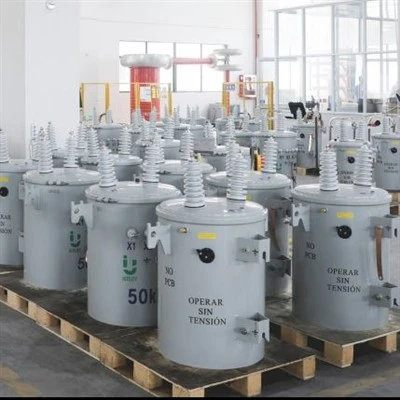
Hey everyone, if you’ve ever stood next to a neighborhood distribution transformer during a thunderstorm, you know that crackling, buzzing sound that makes you wonder if the whole grid’s about to short out. As a surge arrestor supplier, I get asked this question all the time: what even is the point of that pylon-looking thing bolted right next to that big gray box? It’s not just there for show—let me break this down like I would for a field tech who’s been pulling all day, no stuffy textbook jargon required. Surge Arrestor

First, let’s set the scene: distribution transformers are the workhorses of the power grid. They take super high-voltage power from the substation (like 10kV to 35kV, for the non-energized folks) and drop it down to the 120/240V that powers your fridge, your kid’s Xbox, and that window AC you refuse to turn off until August. The problem? Power lines out on the poles or buried underground are sitting ducks for two main things that can blow them sky-high: lightning strikes and switching surges. That’s where the surge arrestor (sometimes people call it a lightning arrestor, but let’s be real, it does more than that) comes in. I’ve been on sites where a single unarrested transformer fried during a tiny thunderclap—costs the utility thousands in repairs and angry customers. Let’s cut through the confusion and get to what this part actually does.
Lightning is the big obvious one. A cloud-to-ground lightning strike can hit a power line directly, dumping a surge of 10,000 amps or more at millions of volts. That’s way more than a distribution transformer is built to handle—those things are designed for steady, controlled voltage, not a giant energy spike that’s basically a lightning bolt. Without a surge arrestor, that surge would blast right through the transformer’s windings, melt the insulation, and turn your local power hub into a paperweight. I’ve seen transformers go up like torches after a strike when the utility skipped adding arrestors on the line side—total avoidable mistake.
But wait, lightning isn’t the only culprit. Switching surges are the ones that fly under the radar and cause way more hidden damage, honestly. When utility workers flip a big switch to turn a line off or on, or when a huge appliance like a factory compressor kicks on, it creates a temporary voltage spike. These spikes aren’t as dramatic as lightning, but they happen all the time—like, multiple times a day, every day. Over months, those tiny spikes add up, wearing down the transformer’s internal insulation bit by bit. It’s like leaving a dent in a car door every time you open it; eventually, the whole door falls off. A good surge arrestor eats those switching surges before they can touch the transformer’s windings, extending its life by years, not months. That’s a huge selling point for us, too—utils are always looking to cut replacement costs, and this is a no-brainer.
Now, let’s talk about how the thing actually works, because it’s not magic (though when it saves a $15k transformer mid-storm, it feels like it). Most distribution surge arrestors use a material called metal oxide varistor (MOV)—that’s the core of every good one we sell. Here’s the trick: MOV is basically a voltage-sensitive sponge. Under normal operating voltage (that 12kV to 25kV sweet spot for most distrib transformers), it acts like an insulator—just sitting there, not doing anything, so power flows normally to the transformer. But the second the voltage gets too high—like 20% over normal, which is when a surge hits—the MOV flips switches and becomes a perfect conductor. It sucks all that extra surge energy to ground, away from the transformer, then snaps right back to being an insulator the millisecond the surge is gone. No mess, no downtime, just instant protection. I’ve tested these in our lab (we do constant stress tests) and they handle multiple surges back-to-back without breaking—way better than the old silicon carbide ones that were around 20 years ago. Our MOV arrestors are built for that specific use case, not the big heavy ones for substation stuff.
Wait, but let’s get real—there are bad surge arrestors out there, and I see them all the time. Some cheap ones skip quality checks, so their MOV wears out fast, or they don’t have the right rating for the transformer’s voltage. A utility tried a cheap import last year and it failed after just two lightning hits, turning the transformer it was supposed to protect into scrap. We always tell folks to match the arrestor’s rating exactly to the transformer’s primary voltage—too low, and it’ll trigger during normal operation, blowing fuses left and right; too high, and it won’t kick in when a surge hits. It’s not one-size-fits-all, and that’s part of our job as a supplier—we don’t just drop a box on a loading dock, we help utils pick the right one for their lines, their transformers, their local storm patterns.
Another thing I don’t hear enough people talk about: surge arrestors protect more than just the transformer. That voltage spike that blows a transformer? It can also fry every electronic device on the line—your TV, your laptop, your kid’s tablet. So it’s not just a power grid issue, it’s a residential reliability issue. I’ve gotten calls from homeowners whose TVs died in a storm, and when we check, the transformer didn’t have an arrestor. That’s a bad look for the utility, and it’s preventable. A $200 surge arrestor saves a household $1,000+ in electronics, plus the utility’s repair costs. It’s a win for everyone.
Let me also clear up a common myth: surge arrestors aren’t just for thunderstorm-prone areas. Sure, if you live in Florida or Ohio, you need them, but even places with few lightning strikes have switching surges. A factory 10 miles away turning on a big motor can send a surge all the way down the line to a quiet suburban transformer, no lightning involved. I had a customer in Montana call me last winter—they had a transformer failure, no storms for weeks, just heavy snow and power line switches being flipped to clear ice. Turns out the old arrestor there had degraded, and the switching surge from line maintenance blew the transformer. We swapped it out, and they haven’t had an issue since. So don’t skip them just because your area is “low-lightning”—those surges are always lurking.
Now, how do you size a surge arrestor? Let’s keep it simple for you folks who aren’t grid engineers. First, match its rated voltage to the transformer’s primary voltage. For example, a transformer rated for 15kV primary needs a 15kV surge arrestor. Second, check the discharge current—most distribution lines need a 10kA discharge (that means it can handle 10,000 amps of surge) because that covers almost all lightning and switching surges. Anything lower, and it might not cut it. And third, make sure it’s mounted close to the transformer—like, within 10 feet. The farther it is, the more the surge has time to build up before it hits the arrestor, so it’s basically useless. I always drill that into our clients—mount it right next to the transformer, don’t leave it on a separate pole 50 yards away.
As a surge arrestor supplier, I’ll be honest: we’re not in the business of selling parts. We’re in the business of saving utils and homeowners time, money, and headaches. We offer pre-calibrated arrestors, free site assessments, and 24/7 tech support if someone has an emergency. Last month, a utility in Illinois had a transformer fail after a storm at 2 a.m. We had a truck with spare arrestors on the road in 45 minutes, helping them swap out the bad one before more lines went down. That’s the stuff no one talks about, but it’s what makes the difference between a 4-hour outage and a 20-minute one.
So to wrap this up, let’s recap the purpose, no fancy words: the surge arrestor’s whole job is to keep surges (lightning or switching) away from the distribution transformer. It works by turning on when the voltage gets too high, draining the extra energy to ground, and turning right back off—all faster than you can blink. It protects the $10k-$20k transformer, it protects your home electronics, and it saves the utility from costly downtime and repair bills.
If you’re a utility tech, a grid manager, or someone who just wants to make sure your local power is reliable, don’t sleep on surge arrestors. We can work with you to find the right size, the right type, and get them installed without hassle. If you’ve got questions about sizing, maintenance, or how to swap out old ones, reach out—we’re here to help. No sales pitch, just real advice for a part that’s way more important than it looks.
Polymer Insulator References:
- American Electric Power. (2021). Distribution Surge Arrestor Application Guidelines.
- IEEE. (2018). Recommended Practice for Surge Protection for Power Distribution Systems.
- National Electrical Manufacturers Association (NEMA). (2020). Surge Arrestor Performance Standards for Distribution Transformers.
EC Insulator Jiangxi Co., Ltd.
EC Insulator Jiangxi Co., Ltd. is one of the most experienced surge arrestor manufacturers and suppliers in China, also supports custom service. Please feel free to wholesale advanced surge arrestor made in China here from our factory. Contact us for more details.
Address: Yuanyang Road, Wuyuan County, Shangrao City, Jiangxi Province China
E-mail: info@ec-insulators.com
WebSite: https://www.eci-elecglobal.com/
