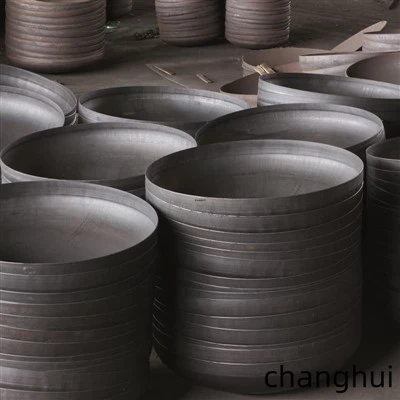
As a tank heads supplier, I get asked this question at least three times every week when a new project kicks off: “What exactly do we need for surface finish on our tank heads?” It’s not a trivial detail—get this wrong, and you’re looking at premature corrosion, product contamination, or even a tank that fails its regulatory inspection. Over the 12 years I’ve worked with metal spinning, deep drawing, and custom tank head manufacturing, I’ve learned that surface finish isn’t a one-size-fits-all spec. It ties directly to what the tank will hold, where it’ll operate, and what standards it has to meet. Let’s break this down like I’d explain it to a project engineer who’s double-checking their drawing before they hit “send” for a quote. Tank Heads

First, let’s start with the basics: surface finish isn’t just about how smooth a head feels when you run a hand over it. It’s a measurable set of texture characteristics: Ra (average roughness), Rz (average peak-to-valley depth), and sometimes Rmax (the single deepest valley) depending on the industry. Ra is the most common shorthand, but I’ve seen plenty of engineers miss that a 16 Ra spec for food service means something way different than 16 Ra for a pressure vessel holding chemical waste. The difference comes down to functionality, not just a number on a blueprint.
Let’s walk through the core industries that our tank heads go into, because each has its own non-negotiable requirements. I can tell you from experience that a head for a beer brewery won’t need the same finish as one for a pharmaceutical bioreactor. For food and beverage applications, the FDA’s 21 CFR Part 110 is the rule here. The FDA requires that all product-contact surfaces have a maximum Ra of 0.8 micrometers (32 microinches) for parts that come into direct contact with food, and 1.6 micrometers (63 microinches) for surfaces that are only in the tank’s internal atmosphere. Why? Even tiny peaks and valleys trap food residue, and if that residue isn’t properly cleaned between batches, it can cause spoilage, cross-contamination, or foodborne illness. I’ve had a craft brewery come to us once with a reconditioned tank head that had a 2.4 micrometer (94 microinch) Ra—they tried acid cleaning and mechanical buffing, but the valleys were too deep. Ended up having to scrap it and go with a new head from us, and we matched their 0.8 Ra spec no problem. That’s the kind of mistake I want to help clients avoid upfront.
Next up, pressure vessels and industrial chemical tanks. These are often regulated by ASME Boiler and Pressure Vessel Code, Section VIII, Division 1, which is the gold standard in North America. For pressure-containing heads, especially those holding corrosive chemicals or operating at high pressures, surface finish is tied to corrosion resistance. Roughness here works like a gateway: tiny valleys create crevice corrosion points, and any surface irregularity can initiate stress corrosion cracking (SCC) when the tank is under pressure. For most carbon steel pressure heads, we typically recommend a maximum Ra of 3.2 micrometers (125 microinches), but for heads made from stainless steel or alloys like Hastelloy or Incoloy (used for hydrochloric or sulfuric acid), we bump that down to 1.6 micrometers (63 microinches). I remember a chemical processing plant that brought us a head they’d imported overseas; their inspection team found Rmax of 12.7 micrometers (500 microinches) on the internal surface. Within six months, they had 17 small corrosion pits forming along the valleys, which required a costly shutdown and repair. Now they specify our 1.6 Ra spec on every head we make for them—no exceptions. That’s the cost of cutting corners on surface finish.
Then there’s pharmaceutical and biotech equipment, which has even stricter rules than food service. These tanks hold drugs, vaccines, or cell cultures, where even a single particulate from a rough surface can ruin a batch worth hundreds of thousands of dollars. The FDA’s 21 CFR Part 211 and GMP (Good Manufacturing Practices) guidelines require product-contact surfaces to have a maximum Ra of 0.4 micrometers (16 microinches). Some biotech clients even ask for electro-polishing after forming the head, which smooths out the micro-peaks and creates a passive oxide layer that’s extremely resistant to contamination. We did a set of tank heads for a mRNA vaccine producer last year—they needed seamless hemispherical heads, and our metal spinning process let us form them in one piece, then we electro-polished the internal surface to 0.2 Ra (8 microinches). They told us that the finish passed their final contamination test with zero particulates, which was a huge relief for their timeline. The last thing a biotech startup needs is a head that delays their clinical trial because of a surface texture failure.
Outside of product-contact surfaces, we also have external surface finish requirements, mostly for corrosion resistance and aesthetic needs. For tanks that are outdoors, buried, or exposed to the elements, external roughness matters because it affects how well paint, powder coating, or galvanization adheres. A too-smooth external surface will cause paint to peel off prematurely, while a too-rough surface will trap moisture under the coating, leading to rust. For most external finishes, we recommend an Ra between 6.3 and 12.5 micrometers (250 to 500 microinches)—it’s a middle ground that lets coating systems bond properly without creating too many points for moisture to get in. We had a municipal water treatment facility last year that wanted a powder-coated external finish; their original drawing only said “smooth” without a number. We tested a few finish samples and landed on 8 Ra, and their coating supplier confirmed that it was the sweet spot for long-term adhesion. That’s another common pain point: vague “smooth” specs that lead to wasted time during coating.
Now, let’s talk about how we achieve these finishes as a tank heads supplier, because it’s not just about buffing after forming. The process starts way before the head is even shaped. For carbon steel heads, we use hot rolling or cold drawing, depending on the spec, then perform a series of grinding and polishing steps tailored to the final Ra. For stainless steel, we always use cold forming (not hot, which leaves a rougher oxide layer) and then either mechanical polishing or electro-polishing, depending on the client’s needs. We also measure every head with a surface roughness tester before it leaves our facility—no exceptions. I’ve had clients ask us to skip the final inspection step, but I never do. One time, a client tried to take a head without our standard testing, and when they tested it on their own, they found Ra was 2.4 micrometers instead of the 1.6 they ordered. It cost them a week of downtime to rework, and they told me later they wished we’d insisted on testing before shipment. That’s why transparency around our quality control is non-negotiable for me.
Wait, there’s another point I almost missed: compatibility with cleaning processes. A lot of people focus on Ra, but surface texture also affects how well CIP (Clean-in-Place) systems work. CIP uses high-pressure water, chemicals, and sometimes steam to clean internal tank surfaces. A rough surface means the cleaning solution doesn’t reach into every valley, so bacteria or residue can hide there. For CIP-capable tanks, we always recommend a minimum Ra of 0.8 micrometers for food and 0.4 for pharma, because CIP systems are designed to work on smooth surfaces. If you have a head that’s too rough, even if it meets the Ra spec, your CIP cycle won’t be effective. We learned that early on when a winery switched to a new CIP system and their old head had 3.2 Ra—they noticed residual yeast after cleaning, so they called us to upgrade to 0.8 Ra, and the problem went away. It’s a detail that’s easy to overlook, but it’s critical for long-term maintenance.
I also get asked about special cases: heads for cryogenic storage, like liquid nitrogen tanks. Those have to handle extreme temperature swings, and surface finish affects thermal insulation and crack resistance. For cryogenic tank heads, we recommend a maximum Ra of 1.6 micrometers, same as corrosive chemical tanks, because rough surfaces act as stress raisers when the metal contracts and expands. We did a set of elliptical heads for a research lab’s liquid hydrogen storage tank last year, and their engineering team specifically noted that the smooth finish reduced the risk of thermal fatigue cracks. Cryogenic applications don’t mess around—one small crack can lead to a catastrophic failure, so surface finish is a key part of their safety plan.
Now, let’s talk about common mistakes I see engineers making when specifying surface finish. The biggest one is using a generic spec that doesn’t account for the tank’s specific use case. I’ve seen a food tank specify 0.8 Ra, which is correct, but then the external surface is also set to 0.8 Ra—way too smooth for coating. Another mistake is mixing up Ra units: microinches vs. micrometers. 32 microinches is 0.8 micrometers, but I’ve had clients accidentally specify 32 micrometers, which is equivalent to 1250 microinches—absolutely way too rough for food service. That’s why we always flag unit mix-ups when we review a quote; it’s a small thing, but it saves everyone a lot of hassle.
If you’re not sure what surface finish you need for your tank head, here’s a quick checklist I always give clients: First, identify what’s product-contact vs. non-product-contact. Second, check the regulatory standards for your industry (FDA, ASME, GMP, etc.). Third, think about your maintenance and cleaning processes (CIP, chemical washing, etc.). Fourth, consider the operating environment (corrosive chemicals, outdoor exposure, cryogenic temps). Once you have those four points, the surface finish number will make itself clear.
At the end of the day, surface finish on tank heads isn’t a arbitrary spec—it’s a foundational part of safety, compliance, and long-term performance. As a supplier who’s worked on hundreds of projects across every major industry, I can tell you that taking the time to get this right up front saves thousands in repairs, downtime, and compliance issues down the line. If you’re currently designing a new tank, replacing a worn head, or need help refining your surface finish specs, don’t hesitate to reach out. We’ll work with your engineering team to make sure the spec matches your exact needs, no one-size-fits-all, no guesswork.
Tank Heads references
ASME Boiler and Pressure Vessel Code, Section VIII, Division 1
FDA 21 CFR Part 110 (Food Manufacturing)
FDA 21 CFR Part 211 (Pharmaceutical GMP)
ASTM A967, Standard Specification for Chemical Passivation Treatments for Stainless Steel Parts
Cangzhou Changhui Head Manufacturing Co., Ltd.
We are one of the most professional tank heads manufacturers and suppliers in China, featured by quality products and good price. Please rest assured to wholesale durable tank heads for sale here from our factory. Welcome to view our website for more information.
Address: South Industrial Zone, Yanshan County, Cangzhou City, Hebei Province, China.
E-mail: chunle.zhang@changhuitankhead.com
WebSite: https://www.changhuitankhead.com/
